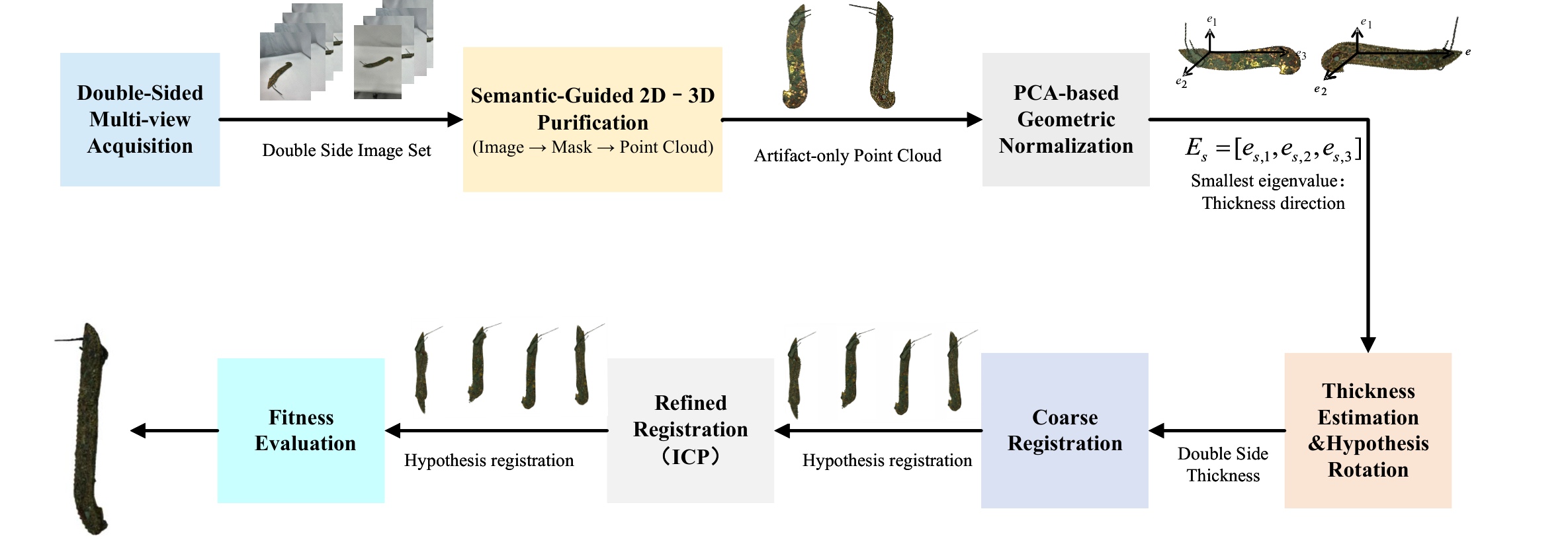
Uses the physical thickness of thin artifacts as a geometric prior to prevent non-physical collapse during registration.
Abstract
Non-contact three-dimensional reconstruction of thin, sheet-like heritage artifacts poses significant geometric and registration challenges. Due to their fragility, these artifacts cannot be suspended or equipped with artificial markers, necessitating independent acquisition of their front and back surfaces. Subsequent registration proves difficult due to the limited number of shared geometric features and the scarcity of explicit physical constraints, which may result in rotational ambiguity, instability, and structural collapse during iterative optimization. To address these challenges, we propose a geometry-constrained bidirectional point cloud registration method specifically tailored for thin, sheet-like heritage artifacts. The method integrates semantic-guided preprocessing, Principal Component Analysis (PCA)-based geometric normalization, and a thickness-aware registration strategy. The estimated physical thickness is incorporated as a geometric constraint to preserve structural integrity during registration. Rotational ambiguity is resolved by evaluating a finite set of global rotation hypotheses, each refined using the point-to-plane Iterative Closest Point (ICP) algorithm, with the optimal transformation selected via a geometry-aware fitness criterion consistent with the thickness scale. Experimental results show that the proposed method achieves competitive or improved performance in most cases, particularly in projected area consistency and physically plausible front-back alignment. In addition, the thickness-aware constraint and rotation-hypothesis evaluation reduce the risk of degenerate configurations in which the two surfaces are incorrectly flipped while still yielding deceptively acceptable numerical scores, supporting reliable non-contact digitization of delicate and thin heritage artifacts. Implementation details will be made available upon publication.
Evaluates rotation hypotheses from canonical axes and selects the transformation that best preserves geometry.
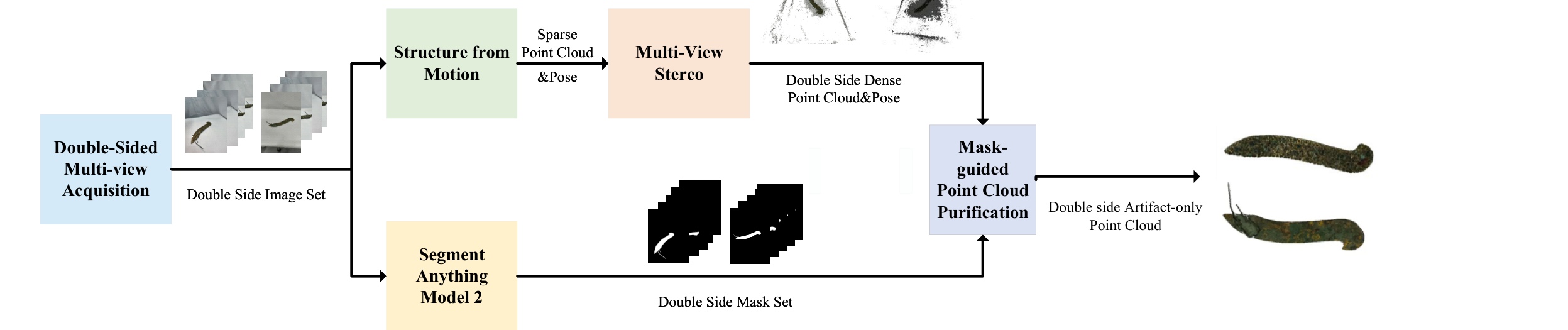
Combines image masks and 3D reconstruction cues to remove background and produce artifact-only point clouds.
Method
The method treats front- and back-side acquisition as two independent reconstruction problems before registration. It first purifies the reconstructed point clouds using image masks, then normalizes the artifact geometry with PCA, estimates the physical thickness direction, evaluates a finite set of rotation hypotheses, and finally refines the selected alignment with thickness-aware ICP.